

Nexus Neuropsychiatry PLLC
(585) 460-9835
MON – FRI: 10am – 7:00pm
SAT – SUN: Closed
*By Appointment Only
Share Article
Article medically reviewed by Dr. Shane Stegen of Nexus Neuropsychiatry PLLC
If you clicked on this article, you're probably in one of two camps. Maybe you've heard the term and want to know more. Or maybe you've never seen it and you're wondering what in the world it means. Either way, the easiest way to understand interventional psychiatry is to understand where it came from.
Interventional Psychiatry Quick Summary
A growing set of treatments for when medication and talk therapy haven't been enough.
-
What it is
Treatments that aim to influence neural activity, brain circuits, or specific pathways, beyond a pill or talk therapy.
-
Examples
TMS, IV ketamine, Spravato, ECT, VNS, at-home stimulation devices, and neurofeedback.
-
Where it happens
Mostly in an outpatient office. Some in a hospital, and a few at home with the right supervision.
-
Who it's for
People with severe symptoms, or who have tried several treatments without getting relief.
Each treatment has its own effectiveness and side effect profile, and none works for everyone.
Skills and Pills
Depression by the Numbers
- 1 in 6
US adults (16.2%) meet criteria for major depressive disorder at some point in their lives.
Source: Kessler et al., JAMA, 2003
- 21 million
US adults (8.3%) had at least one major depressive episode in 2021.
When the First Treatment Doesn't Work
STAR*D remission rate at each treatment step, among people who entered that step.
reached remission after up to four treatment steps. About 1 in 3 still had not.
Source: Rush et al., American Journal of Psychiatry, 2006 (STAR*D)
Enter Interventional Psychiatry
This was frustrating for people struggling with symptoms as well as the practitioners treating them. Things are changing though. In recent years, a number of treatments have come along that aren't just another talk therapy or pill. We have new ways that change how the brain is functioning to actually target the circuits that are disrupted and help them get back to a normal rhythm. Some examples are TMS, IV ketamine, Spravato, neurostimulation devices like VNS, neurofeedback, as well as others. Because they all require some type of more advanced delivery rather than just taking a pill at home or doing talk therapy, the field has started describing them as interventions, similar to other fields of medicine where treatments have a procedural element.
Interventional psychiatry isn't one treatment or even one type of treatment, and it isn't built for one diagnosis. The hope is that new therapies keep coming for many different problems. What the treatments share is that they aim to influence neural activity, brain circuits, or specific pathways. Most of these treatments are done in an office on an outpatient basis. Some can be done in a hospital, and a few can even be done at home with the right supervision.
Examples of Treatments Within Interventional Psychiatry
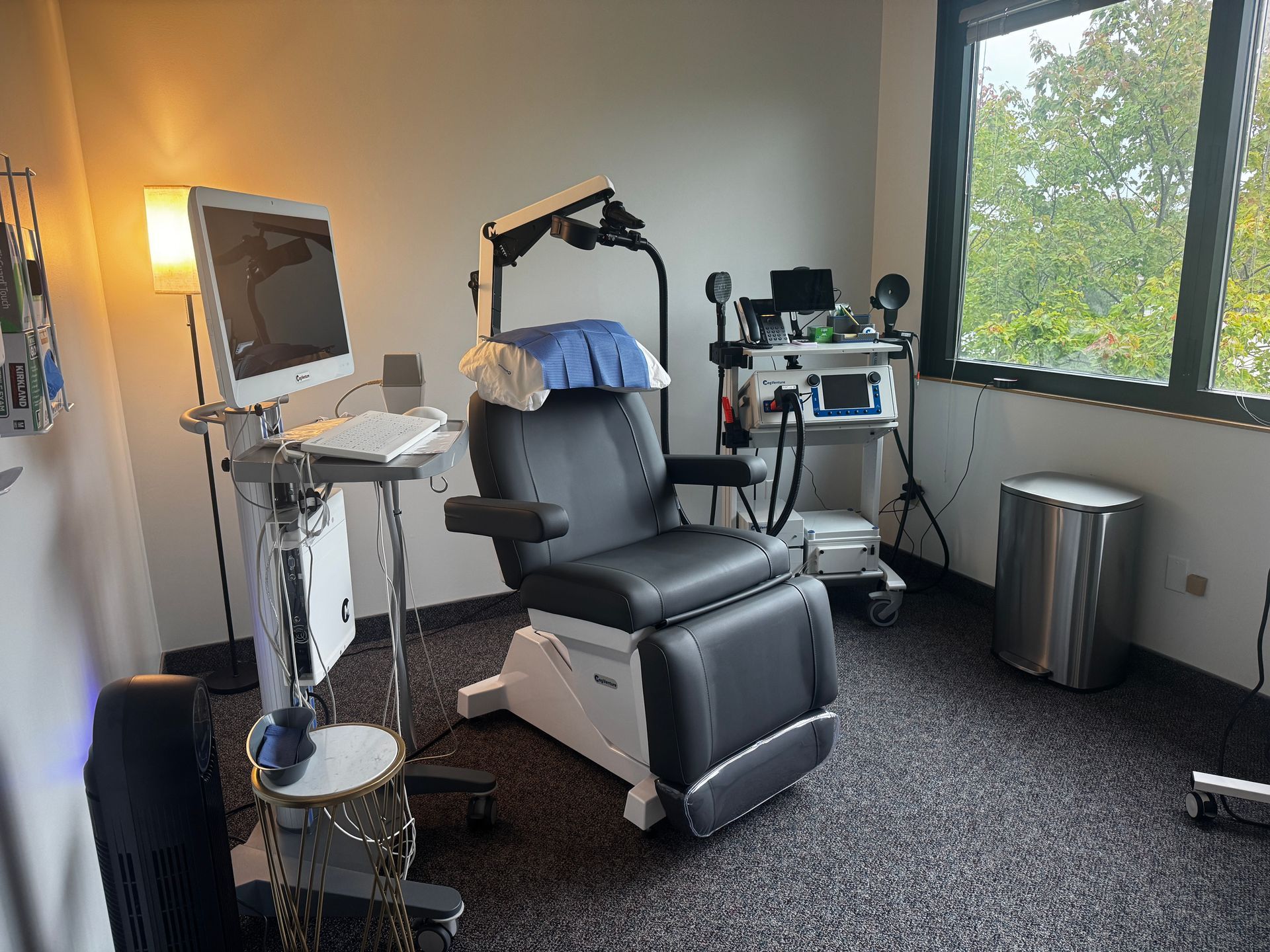
TMS (transcranial magnetic stimulation). TMS is a non-invasive treatment that uses magnetic pulses to stimulate specific areas of the brain. It's FDA-cleared for depression and OCD, and research continues in other areas, including substance use disorders.
IV ketamine. Ketamine is a dissociative anesthetic that was found to be effective for depression and several other psychiatric symptoms. It remains off-label for these uses, which means it hasn't been approved by the FDA for treating them, but there are many years and scientific papers providing strong evidence.
Spravato (esketamine). Spravato is a ketamine-derived medication that is FDA-approved for treatment-resistant depression. It's given in a certified healthcare setting under a safety program called REMS.
ECT. An established treatment with a long track record. It can be very effective but also comes with more significant side effects and barriers due to logistics, as in New York it is only provided in hospital settings.
Vagus nerve stimulation (VNS). This uses an implanted device to change brain patterns and treat severe and chronic symptoms of depression.
Afferent nerve stimulation and transcranial direct current stimulation (tDCS). These are newly FDA-approved medical devices that can be taken home and provide daily treatments for depression.
Neurofeedback systems. There are FDA-approved neurofeedback systems for treatment of depression.
Like any medical treatment, each has its own effectiveness and side effect profile, and none works for everyone.
Why These Aren't the First Thing We Try
Most of these treatments aren't first-line, and the reasons are pretty practical. Many of the new treatments tend to be hard to access: insurance can be a hurdle and not many clinicians are trained to prescribe or deliver them yet.
There's also a bigger reason: they take more time, supervision, and precision than something like a pill, which takes 5 seconds to administer and then you are on with your day. Although the term interventional may sound serious, I wouldn't say these treatments are always more invasive or less safe than an oral medication.
Who Might Benefit
The simple answer is anyone whose symptoms are severe enough that they're looking for a faster or more effective treatment, and anyone who has already tried several treatments without getting relief. If that's you, you're exactly who we see.
As we learn more about how the brain works and how well these treatments perform, they're being used earlier in the course of illness. The goal is to help people avoid struggling longer than they need to, and to act as a line of defense before someone needs a higher level of care like hospitalization.
Frequently Asked Questions
Is interventional psychiatry the same as ECT?
No. ECT is one of the treatments within interventional psychiatry, but the field also includes TMS, ketamine-based treatments, and newer neuromodulation options.
Do I have to stop my medication or therapy?
Not necessarily. Many people continue medication or therapy alongside these treatments. Our experts will go over what makes sense for you.
Is insurance likely to cover it?
Coverage varies by treatment and plan, but both TMS and Spravato have good coverage on most plans including Medicare and Medicaid. Our team can help you understand your options.
How do I know if I'm a candidate?
Anyone struggling with symptoms that have not responded to medications or psychotherapy is a candidate for these treatments. Email or call our office and we can provide screenings to see exactly what the next steps are and explore your specific coverage.
The Future of Faster Depression Treatment
If standard treatments haven't given you the relief you hoped for, or you'd rather not wait to find out, we'd be glad to help you work out your next step. Contact Nexus Neuropsychiatry in Rochester, NY to
schedule an evaluation.
Ready to Talk About Your Next Step?
If standard treatments haven't given you the relief you hoped for, we can help you work out what comes next. Schedule an evaluation at our Rochester, NY office.
IV ketamine is used off-label for depression and other psychiatric conditions. While growing evidence supports its use, it has not received FDA approval for these indications. Your provider will discuss what the current research shows and what it does not. Spravato (esketamine) is available only through certified healthcare settings under the FDA's REMS program.
References
- Kessler RC, Berglund P, Demler O, et al. The epidemiology of major depressive disorder: results from the National Comorbidity Survey Replication (NCS-R). JAMA. 2003;289(23):3095-3105.
- National Institute of Mental Health. Major Depression (statistics page; data from the 2021 National Survey on Drug Use and Health, SAMHSA). nimh.nih.gov/health/statistics/major-depression
- Rush AJ, Trivedi MH, Wisniewski SR, et al. Acute and longer-term outcomes in depressed outpatients requiring one or several treatment steps: a STAR*D report. Am J Psychiatry. 2006;163(11):1905-1917.