
Nexus Neuropsychiatry PLLC
(585) 460-9835
MON – FRI: 10am – 7:00pm
SAT – SUN: Closed
*By Appointment Only
Share Article
Article medically reviewed by Dr. Shane Stegen of Nexus Neuropsychiatry PLLC
Depression can hang on through medication, therapy, and everything else you've tried. That's frustrating, and it's a big reason interventional psychiatry exists. These treatments go after depression differently than medication management alone, and they also differ from each other in how they work, how they're delivered, how quickly benefits may appear, and what a course of treatment asks of you. This guide walks through four of the main options we offer at Nexus Neuropsychiatry: traditional TMS, accelerated TMS, Spravato, and IV ketamine. We'll touch on VNS, ECT, and Proliv Rx too. For the basics first, read What Is Interventional Psychiatry?
This is a comparison, not a ranking. The best option is the one that fits your clinical needs, your treatment history, your preferences, and your life.
Four Treatments at a Glance
A comparison, not a ranking. The best option is the one that fits your clinical needs, treatment history, preferences, and life.
- Magnetic stimulation
Traditional TMS
What it is Magnetic pulses to targeted mood circuits. You stay awake, with no anesthesia and no systemic medication.
What it asks of you Short outpatient visits, typically five days a week for several weeks.
- Magnetic stimulation
Accelerated TMS
What it is Multiple TMS sessions per day, so an initial course can finish in days instead of weeks.
What it asks of you Intensive treatment days. Protocols vary, and some add off-label medications.
- Esketamine nasal spray
Spravato
What it is An FDA-approved nasal spray for treatment-resistant depression in adults that acts on the glutamate system.
What it asks of you At least two and a half hours per visit, including monitoring, plus a ride home.
- Infusion, used off-label
IV Ketamine
What it is An infusion of about 40 minutes under medical monitoring, followed by recovery time.
What it asks of you An initial series of four to six infusions over two to four weeks, plus a ride home.
Individual results vary, and no treatment works for every person.
Four Options to Review in Detail
Traditional TMS
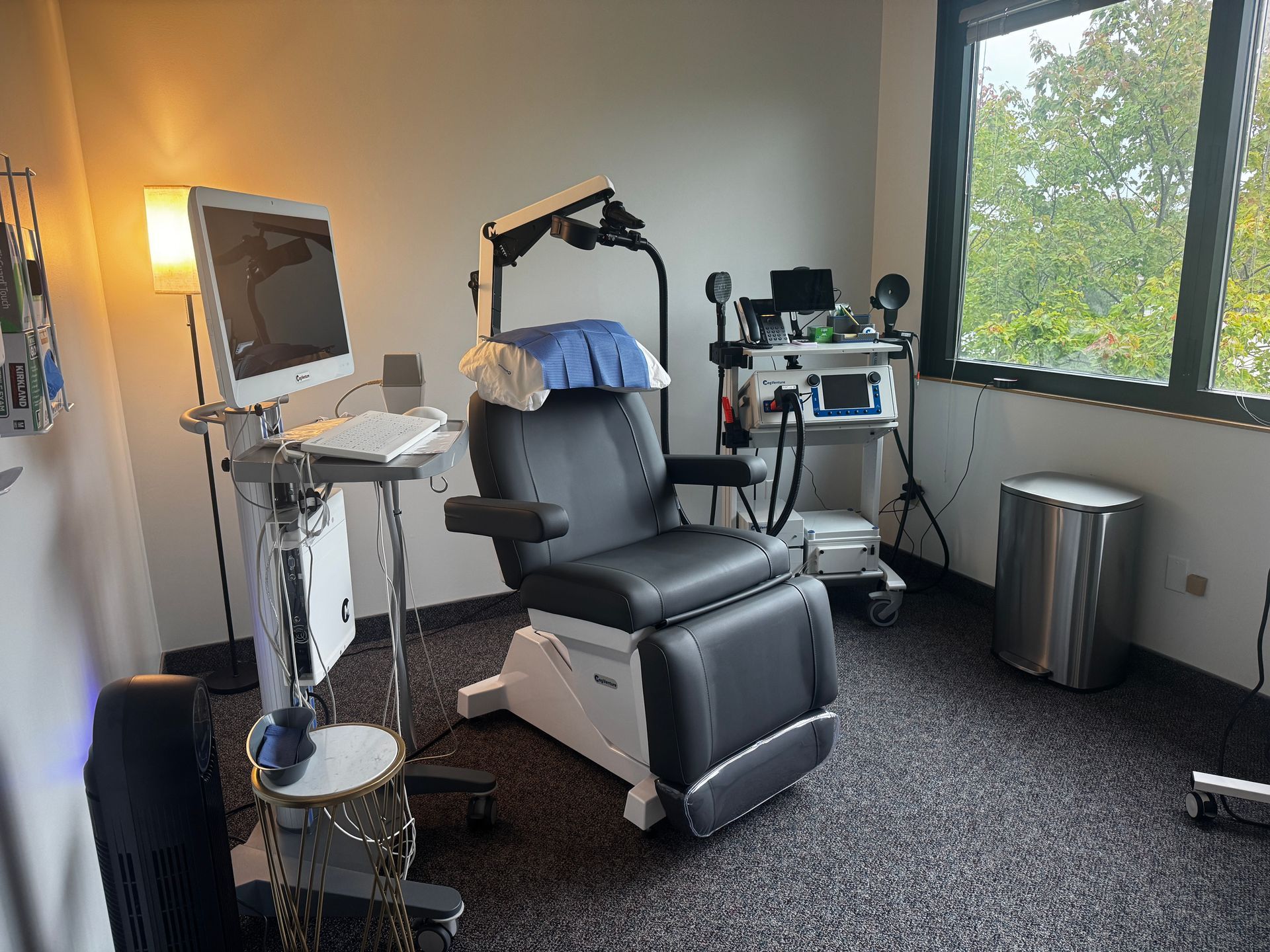
TMS therapy uses magnetic pulses to stimulate targeted brain circuits involved in mood regulation. It's noninvasive and needs no anesthesia. You sit in a chair with a coil resting on your scalp and you're awake the whole time. A standard course is repeated outpatient sessions, typically five days a week for several weeks. There's no systemic medication, and most people go back to their day right afterward. Side effects are usually scalp discomfort or headache, and there's a rare risk of seizure. TMS is FDA-cleared for major depression, and it's most often considered by people who haven't improved enough with antidepressants.
Accelerated TMS
Accelerated TMS works on the same principle but delivers multiple sessions per day over a much shorter period, so an initial course can finish in days instead of weeks. Protocols differ in stimulation pattern, targeting, intensity, and schedule. At Nexus, we offer accelerated protocols, including neuroplastogen-enhanced versions, ranging from one to five or more days with up to 10 treatments per day. The tradeoff is intensive treatment days. It's also worth separating established protocols from newer ones. Accelerated TMS is not one standardized treatment, so results from one protocol shouldn't be assumed for another, and enhanced protocols involve off-label medications with evidence that is still developing.
Spravato
Spravato is the brand name for esketamine, a prescription nasal spray. It acts on the glutamate system instead of serotonin, norepinephrine, or dopamine like many traditional antidepressants. It's FDA-approved for treatment-resistant depression in adults, alone or with an oral antidepressant, and for depressive symptoms in adults with major depressive disorder and acute suicidal ideation or behavior, alongside an oral antidepressant.[3] You use the device yourself under supervision and are monitored for at least two hours afterward, so plan on at least two and a half hours at the office and arrange a ride home. Some people improve fairly early in treatment. Common side effects include dissociation, dizziness, nausea, sedation, and temporary increases in blood pressure. Spravato is a regulated medication with specific indications and monitoring requirements.
IV ketamine
IV ketamine
and Spravato are related, since both act on glutamate signaling, but they're not interchangeable. Ketamine given by infusion is used off-label for depression, and the formulation, regulatory status, administration, evidence, and protocols all differ from Spravato. An infusion takes about 40 minutes under medical monitoring, followed by recovery time, and an initial series is typically four to six infusions over two to four weeks.[4] Some people improve within hours or days. That early response needs to be judged over time, and it doesn't mean one infusion gives lasting benefit. Screening matters, including blood pressure and psychiatric history such as psychosis or mania, and common side effects include dissociation, drowsiness, and nausea.
Side by Side: TMS, Accelerated TMS, Spravato, and IV Ketamine
Here's a quick overview. It describes typical approaches, not promises.
Schedules and outcomes depend on the protocol and on you.
| Feature | Traditional TMS | Accelerated TMS | Spravato | IV ketamine |
|---|---|---|---|---|
| Treatment type | Magnetic brain stimulation | Magnetic stimulation compressed into more sessions per day | Prescription nasal spray | Intravenous medication |
| How it works | Stimulates targeted brain circuits | TMS with more frequent sessions; some protocols use individualized targeting or neuroplastogens | Acts on NMDA receptors and glutamate signaling | Acts on NMDA receptors and glutamate signaling |
| Typical schedule | 36 treatments: 30 weekday sessions over several weeks, then a few per week for the remaining 6 | Multiple sessions daily over 1 to 5 or more days, depending on the protocol | Twice a week for the first month, then adjusted to maintain gains, usually weekly or every other week | 4 to 6 treatments over 2 to 4 weeks, then as often as needed to maintain benefit |
| How quickly benefits may appear | Often builds over the course of treatment. We look for improvement between weeks 3 and 6. | Similar to traditional TMS for most protocols | Some people notice benefits within the first few doses. We look for improvement by week 7 or 8. | Some people improve within hours or days. We look for improvement by treatment 3 or 4. |
| Anesthesia required? | No | No | No | No Psychiatric doses are subanesthetic. |
| Systemic medication? | No | No Enhanced protocols add medication. | Yes | Yes |
| Monitoring | During sessions only | During sessions only | Supervised dosing and at least 2 hours of monitoring | 2 hours of medical monitoring during and after the infusion |
| Common practical consideration | Frequent clinic visits | Intensive treatment days | Ride home and observation time | Ride home and observation time |
| Regulatory status for depression | FDA-cleared protocols for major depression | Depends on the protocol; some are FDA-cleared, others are not | FDA-approved for treatment-resistant depression in adults | Used off-label |
Individual results vary. Your care team will recommend options based on your history, goals, and eligibility.
How Do You Know Which To Choose?
7 Questions We Work Through Together
Rather than a ranking, these are the questions that shape a plan that fits you.
- How important is speed? Faster delivery isn't the same as faster, bigger, or longer-lasting improvement.
- How much time can you commit? The best plan is one you can attend consistently.
- Do you want to avoid medication exposure? TMS options use no systemic medication, but they still have their own risks and screening.
- What have you already tried? Your history helps guide the choice. It doesn't decide it.
- What are the risks and medical considerations? Each treatment has a different safety profile, so evaluation and monitoring matter.
- What matters most to you? Your preferences are a legitimate part of the decision.
- What if the first treatment doesn't work? We reassess and adjust. Not responding to one treatment doesn't take other evidence-based options off the table.
Other Interventional Options: VNS, ECT, and Proliv Rx
Vagus nerve stimulation (VNS) uses an implanted device that stimulates the vagus nerve. It's considered for selected patients with chronic or treatment-resistant depression as a longer-term add-on, and benefits can develop gradually. It involves a surgical implant, which makes it a different kind of treatment than outpatient magnetic stimulation.
Electroconvulsive therapy (ECT) is a well-established treatment that induces a brief, controlled seizure under general anesthesia. It's considered for severe or treatment-resistant depression and when a rapid, substantial response is especially important. Anesthesia, recovery, and potential cognitive side effects are part of the picture. ECT remains an important option, and in some situations it's the more appropriate treatment. In New York it's only provided in hospital settings, but our psychiatrists still deliver ECT for the area hospital system so we are very familiar with the risks and benefits.
Proliv Rx is a prescription device that delivers external combined occipital and trigeminal afferent stimulation and is designed for patient-administered treatment at home under clinician direction. The FDA approved it in January 2026 as an adjunctive treatment for adults with major depressive disorder who haven't improved enough with at least one antidepressant.[5] In the randomized, sham-controlled MOOD study of 124 adults, symptoms improved more with active stimulation than with sham over eight weeks.[6] Its mechanism and schedule differ from TMS, it isn't a substitute for TMS or any other treatment, and clinical experience with it is newer. It may interest people who want a treatment they can use at home.
Can These Treatments Be Combined?
Sometimes. These treatments aren't always mutually exclusive, and a clinician may use them in sequence or, in selected cases, together as part of a broader strategy. Combinations are individualized, with attention to safety, evidence, and how much treatment you're taking on. More isn't automatically better, so we look at whether each treatment is adding something. For example, someone who improves partway with one treatment may switch to or add another, and we revisit the plan along the way.
What Does an Evaluation Look Like at Nexus?
We review your symptoms, psychiatric history, and previous treatments, then your medical history, medications, and safety considerations. We go over the available options and how they differ, along with your goals, preferences, and practical constraints, and build an individualized plan. Then we measure your symptoms and functioning over time to see whether treatment is helping. The purpose is to work out which treatment, or combination, makes the most clinical sense for you.
Your Evaluation at Nexus, Step by Step
Every plan starts with understanding you, not with a preset treatment.
-
Your history
Symptoms, psychiatric history, and previous treatments.
-
Your health
Medical history, medications, and safety considerations.
-
Your options
The treatments available to you and how they differ.
-
Your plan
Built around your goals, preferences, and practical constraints.
-
Your progress
We measure symptoms and functioning over time to see whether treatment is helping.
The goal is to work out which treatment, or combination, makes the most clinical sense for you.
Different Treatments, One Individualized Goal
Traditional TMS, accelerated TMS, Spravato, and IV ketamine differ in schedule, mechanism, risks, and evidence, and VNS, ECT, and Proliv Rx add options for selected patients. Please don't choose based on one comparison or one advertised response rate. The best next step is an individualized assessment. To learn more, visit our pages on
TMS therapy,
Accelerated TMS,
Spravato, and
IV ketamine, or contact Nexus Neuropsychiatry in Rochester, NY to
schedule a consultation.
Find the Option That Fits You
The best next step is an individualized assessment at our Rochester, NY office.
Individual results vary, and no treatment works for every person. IV ketamine is used off-label for depression and other psychiatric conditions. While a large body of research supports its use, it has not received FDA approval for these indications. Neuroplastogen-enhanced accelerated TMS protocols involve off-label use of medications and have less published evidence than FDA-cleared protocols. Spravato (esketamine) is available only through certified healthcare settings under the FDA's REMS program.
References
- SPRAVATO (esketamine) nasal spray, CIII. Full prescribing information. Janssen Pharmaceuticals, Inc.
- McInnes LA, Aslam AM, Prashad S, et al. Interdisciplinary, Delphi-driven consensus guidelines on the use of intravenous ketamine infusions for depressive disorders from the American Society of Ketamine Physicians, Psychotherapists, and Practitioners (ASKP3). J Affect Disord. 2026;411:121970.
- FDA approves ProlivRx: first prescription, physician-directed, at-home brain neuromodulation therapy for MDD. Psychiatric Times. January 12, 2026.
- A novel home-based, combined occipital and trigeminal afferent stimulation therapy for major depressive disorder: efficacy and safety results from a double-blind multicenter randomized sham-controlled study (MOOD). Brain Stimulation. 2025.